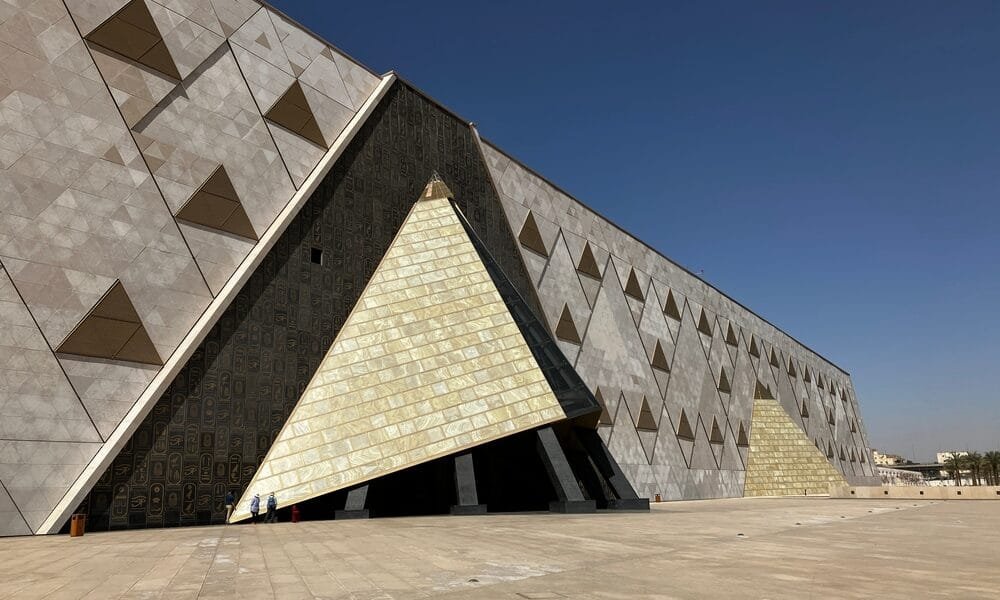
Everyone walks into the Grand Egyptian Museum talking about one thing: the gold mask. And fair enough — Tutankhamun’s burial mask is the most recognizable object in the world, and seeing it up close is a genuine bucket-list moment.
But here is the thing most visitors figure out too late: the GEM holds more than 100,000 artifacts spanning 7,000 years of Egyptian history, and only a fraction of them have anything to do with the boy king. The museum opened fully to the public in November 2025 after more than two decades of construction, and it is now the largest museum in the world dedicated to a single civilisation. You cannot see it all in a day. You should not try.
What you should do is walk past the Tutankhamun queue — at least for an hour — and spend time with the artifacts that tell the rest of Egypt’s story. These are the ten that stopped me in my tracks, and the ones I now tell every traveller not to miss.
The short version: 10 artifacts to see at the GEM
| # | Artifact | Where to find it |
|---|---|---|
| 1 | Colossal statue of Ramesses II | Grand Hall / atrium |
| 2 | Hanging Obelisk of Ramesses II | Exterior entrance plaza |
| 3 | The Grand Staircase | Central spine of the building |
| 4 | Khufu’s solar boat | Khufu’s Boats Museum |
| 5 | Statue of Hatshepsut | Grand Staircase |
| 6 | Sphinx of Amenemhat III | Grand Staircase |
| 7 | Canopic chest of Queen Hetepheres | Main galleries (Old Kingdom) |
| 8 | Heracleion colossi | Grand Hall |
| 9 | Ten statues of Senusret I | Grand Staircase |
| 10 | The ostraca | New Kingdom galleries |
1. The Colossal Statue of Ramesses II (Grand Hall)

You do not really choose to see this one. It sees you.
The moment you pass through the hieroglyph-adorned facade and step into the echoing entrance hall, an 11-metre-tall, 83-ton red granite figure of Ramesses II is staring down at you. He is seated, calm, and almost impossibly large. The statue was found at Memphis in 1820 in six pieces, reassembled, and displayed in a Cairo square for decades before being moved to Giza — it was among the very first artifacts installed here, and the museum was effectively designed around it.
Most people snap a photo and move on. Don’t. Walk a slow circle around the base. Look at the carving on the throne, the alignment of the eyes, the way the scale shifts depending on where you stand. It is the perfect overture for everything else in the building.
2. The Hanging Obelisk of Ramesses II (Entrance Plaza)
This is the one artifact you see before you enter, and almost everyone walks right past it.
A 16-metre, roughly 90-tonne granite obelisk stands suspended above a stone plinth in the entrance plaza — the only obelisk in the world displayed this way. It was brought from Tanis in the Nile Delta, where Ramesses II had raised more than a dozen of them. Step underneath it, look up through the opening built into the base, and you will see something remarkable: the carved cartouches bearing his names, hidden from human eyes for more than 3,200 years until the monument was lifted into this position.
It takes two minutes. It is worth every second. Do it before you go inside, because once you are in the galleries, you will not want to come back out.
3. The Grand Staircase (and What Waits at the Top)
The Grand Staircase is not a single artifact, but it might be the museum’s greatest piece of curation.
More than 60 monumental statues, stelae, columns, and sarcophagi line the staircase, arranged chronologically and divided into themes that move from royal image to divine houses, gods and kings, and finally the journey to eternity. You will pass the seated statue of Thutmose III, the Sphinx of Amenemhat III, a Hatshepsut, and a trinity of Ramesses II with Ptah and Sekhmet.
Then you reach the top, turn around, and a floor-to-ceiling window frames the Great Pyramid of Khufu like a painting. It is the single best view in the entire museum, and it connects the building to the landscape in a way no photograph quite captures. Stand there for a minute. You earned it.
4. Khufu’s Solar Boat (Khufu’s Boats Museum)
If you only see one thing beyond Tutankhamun, make it this.
Dating to around 2500 BCE, the cedar-wood boat of King Khufu was discovered in 1,224 pieces beside the Great Pyramid in 1954. It has been painstakingly reassembled into a 43.4-metre vessel — the oldest intact ship on earth, its planks lashed together with rope rather than a single nail. The ancient Egyptians believed the pharaoh would join the sun god Ra on a cosmic journey after death, and standing beside this boat, that belief stops feeling abstract.
The GEM displays it in a dedicated hall with elevated viewing platforms, so you can walk above it and see the curve of the hull and the precision of the joinery. In the same hall, conservators are reassembling Khufu’s second boat, fragment by fragment, in a live restoration lab — one of very few places in the world where you can watch a 4,500-year-old ship being rebuilt in public.
5. The Statue of Hatshepsut
Hatshepsut is one of the few women to hold full pharaonic power, ruling around 1470 BCE during a time when kingship was firmly a man’s domain. To legitimize her authority, she presented herself in official art as a male ruler — adopting masculine titles, wearing the royal kilt, and even donning a false beard.
The statue in the GEM captures that performance of power. It is not a curiosity or a footnote. It is a political document carved in stone, and it raises questions about gender, authority, and image-making that feel startlingly modern. Most visitors pass it on the staircase without realizing what they are looking at. Now you will know.
6. The Sphinx of Amenemhat III
Egypt has a lot of sphinxes. This one is different.
Carved from a single block of black granite, the Sphinx of Amenemhat III sits on the Grand Staircase and radiates a quiet, brooding presence that the bigger statues sometimes lack. The face is believed by some scholars to be a portrait of the king himself — not an idealized royal mask, but something closer to a human face. The body is a lion’s, the head is a king’s, and the expression is harder to read than any other object in the museum.
It is the kind of piece that rewards a slow look. Give it one.
7. The Canopic Chest of Queen Hetepheres
Tucked into the Old Kingdom galleries is one of the most intimate objects in the entire collection: the alabaster canopic chest of Queen Hetepheres, mother of Khufu. Inside it sat the jars that held her liver, lungs, stomach, and intestines after mummification — among the earliest canopic sets ever found.
What makes it extraordinary is not the gold or the scale. It is the domesticity of it. This is a mother’s burial equipment, prepared with enormous care by people who loved her, and it survived 4,500 years to sit in a glass case in Giza. Most people walk past it on their way to something shinier. They are missing one of the most human moments in the museum.
8. The Heracleion Colossi (Grand Hall)
In the Grand Hall, opposite the giant Ramesses, stand a Ptolemaic king and queen recovered from the sunken city of Thonis-Heracleion. These colossi were raised from the Mediterranean seabed by underwater archaeologists, and they are among the largest Ptolemaic statues ever brought back to land.
The contrast is what makes them unforgettable. Ramesses is all Old Kingdom certainty and monumental scale. The Heracleion figures are later, stranger, and touched by the sea — their surfaces carry the marks of centuries underwater. Seeing them together in the same atrium is a reminder that Egyptian civilization did not end with the pharaohs. It kept going, and it kept making astonishing things.
9. The Ten Statues of Senusret I
On the Grand Staircase, ten near-identical seated statues of Senusret I stand together, and they are easy to walk past because they look repetitive. Look closer.
The group was found in 1894 in a pit beside Senusret’s funerary temple at Lisht, carved from limestone, all showing the king as a young man. Each one is slightly different — the set of the shoulders, the carving of the face, the polish of the stone. Together, they create a rhythm, a visual chant, that communicates something the individual statues cannot: the permanence of kingship, the idea that the pharaoh is not a person but an institution that continues. It is one of the most sophisticated displays in the museum, and it asks for a kind of attention that most visitors do not give it.
Give it thirty seconds. It will change how you see the rest of the staircase.
10. The Ostraca (New Kingdom Galleries)
The last entry is not one object. It is thousands of tiny ones.
In the New Kingdom galleries, cabinets are filled with ostraca — broken flakes of pottery and stone covered in handwriting. These were the ancient Egyptian equivalent of sticky notes: receipts, work rosters, complaints, sketches, doodles, love poems, and messages between the workers who built the royal tombs. Egypt’s celebrated rulers command the spotlight, but the ostraca tell the story of the people who actually built the civilization.
They are small. They are not glamorous. They are the closest thing you will find in the GEM to hearing an ancient Egyptian voice speaking directly to you, and that is worth more than any golden mask.
Practical Notes Before You Go
Opening hours. The museum complex opens at 8:30 AM. Galleries run 9:00 AM to 6:00 PM on Sunday, Monday, Tuesday, Thursday, and Friday, and 9:00 AM to 9:00 PM on Wednesday and Saturday — the two late nights, when the Grand Staircase is at its most atmospheric. Last entry is one hour before the galleries close, so aim to be inside by 5:00 PM (or 8:00 PM midweek).
Tickets. Book online in advance through the official GEM ticketing site, and arrive at opening if you want the atrium and staircase to yourself for even a few minutes. One ticket covers the Tutankhamun Galleries, the main galleries, the Grand Hall and Grand Stairs, Khufu’s Boats Museum, the commercial area, and the gardens.
Getting there. The museum sits about two kilometres from the Giza Pyramids, and a dedicated tourist walkway linking the two is under construction — which will make pairing them in a single day easier than ever. Until then, plan on a short drive between the two sites, and see our guide to the Pyramids of Giza for how to sequence the plateau.
And here is the most important tip: do not treat Tutankhamun as the finale. See the mask, absolutely. But give the rest of the museum the same curiosity. The artifacts on this list are not the warm-up act. They are the reason the GEM exists.
Frequently Asked Questions
How long do you need at the Grand Egyptian Museum?
Plan on at least four hours, and five to six if you want to read labels and see the ostraca cabinets properly. A half-day covers the Grand Hall, the Grand Staircase, Khufu’s Boats Museum, and the Tutankhamun Galleries at a brisk pace. If you only have two hours, do the staircase, the boat, and the mask — in that order.
Is the Tutankhamun mask included in the GEM ticket?
Yes. The Tutankhamun Galleries, including the gold mask, are part of the standard admission ticket, along with the main galleries, the Grand Hall, the Grand Staircase, and Khufu’s Boats Museum. There is no separate ticket for the mask.
Where are these ten artifacts located inside the museum?
Six of the ten are in or around two spaces: the Grand Hall (Ramesses II and the Heracleion colossi) and the Grand Staircase (Hatshepsut, the Sphinx of Amenemhat III, and the ten Senusret I statues). The Hanging Obelisk is outside the main entrance, Khufu’s boat has its own hall, and the Hetepheres chest and the ostraca are in the main chronological galleries.
When is the quietest time to visit the GEM?
The first hour after opening, and the last two hours on a Wednesday or Saturday evening when the galleries stay open until 9:00 PM. Mid-morning on a weekday is the busiest stretch, largely because of group tours heading straight for Tutankhamun.
Can you visit the GEM and the Pyramids in one day?
Yes, and it is the most efficient way to see both. Do the Pyramids early, when the light and the temperatures are best, then move to the museum for the afternoon and stay into the evening. Read our full guide to visiting the Grand Egyptian Museum for tickets, transport, and timing.
More GEM Reading Before You Go
If you are building a GEM day around this list, these will save you time:
- How to explore the Grand Egyptian Museum like a pro — routes, ticketing, and the mistakes to avoid.
- A deep dive into the GEM’s main galleries — what is on each level, and why the order matters.
- Tutankhamun’s legacy at the GEM — the 5,398 objects behind the mask.
- Where to eat at the Grand Egyptian Museum — because four hours is a long time.